Get in touch
I'm always excited to take on new projects and collaborate with innovative minds.
Phone
Email
support@musaiblone.com
Address
Tujjar Sharif, Sopore, Baramulla District, Jammu and Kashmir, India – [193201]
I'm always excited to take on new projects and collaborate with innovative minds.
support@musaiblone.com
Tujjar Sharif, Sopore, Baramulla District, Jammu and Kashmir, India – [193201]
In this article, we discuss the best programming languages to use in cybersecurity in 2025+, why it is important, what types of jobs or tasks each is best suited to, what their trade-offs are, and how to decide what to study (or invest more in specific). At the end, you will have a good map on where to go basing on your goals, strengths, and interests.
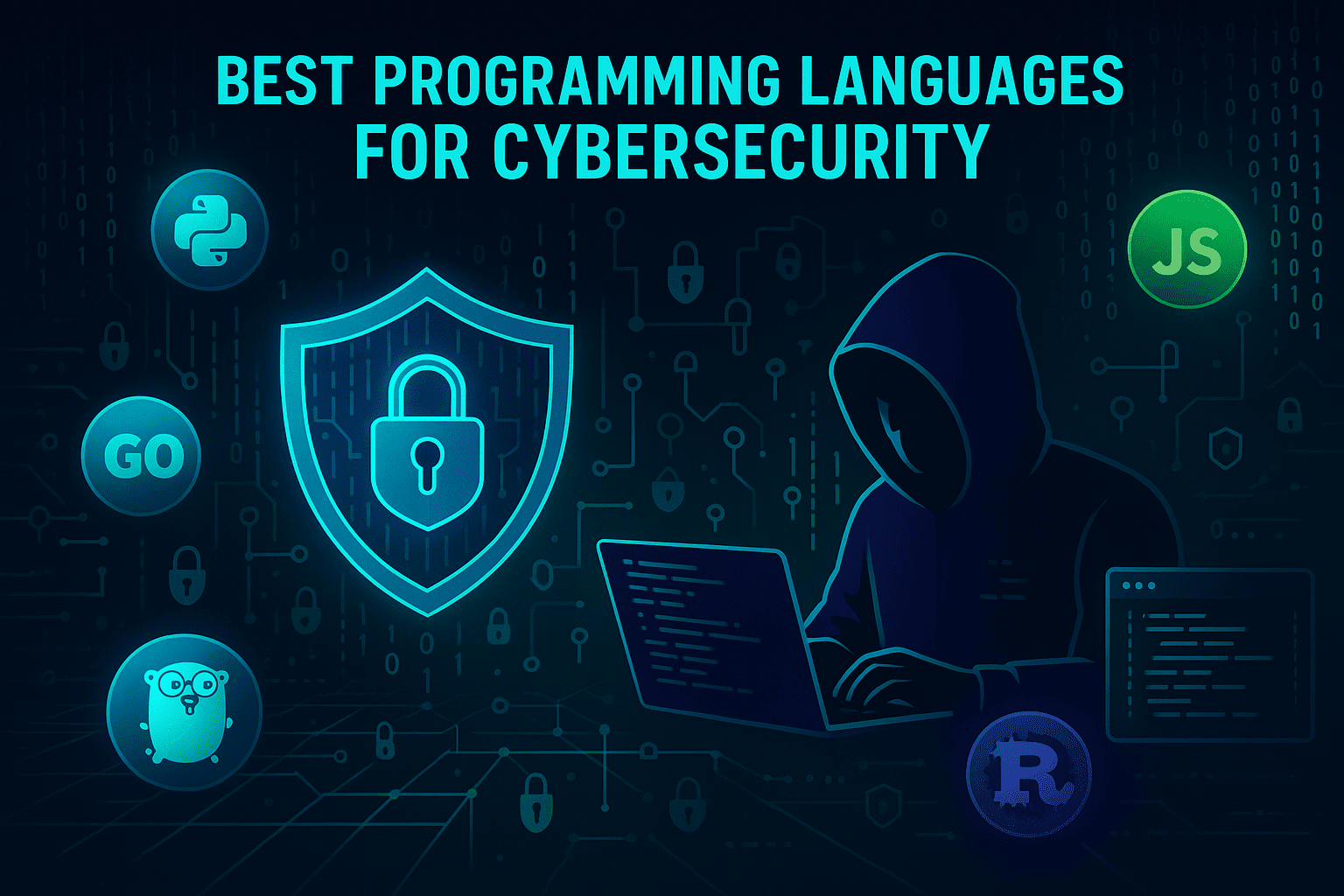
With our contemporary world becoming more and more dependent on digital systems, cybersecurity has become one of the most essential areas. Protecting personal data, securing enterprise infrastructure, frustrating hackers, and safeguarding national security are all fronts where threats may arise. Programming languages lie behind most of the tools, exploits, and defenses of cybersecurity; they are the foundation of the way cyberattacks are made, the way defenses are made, and the way digital investigations are made.
So, assuming a career in cybersecurity (penetration testing, malware analysis, red teaming, blue teaming, security tool development, etc.), one of the questions that immediately pops up is: What programming languages should I learn? What offers you the best leverage, quickest track and the best utility across tasks.
In this article, we discuss the best programming languages to use in cybersecurity in 2025+, why it is important, what types of jobs or tasks each is best suited to, what their trade-offs are, and how to decide what to study (or invest more in specific). At the end, you will have a good map on where to go basing on your goals, strengths, and interests.
It is useful to explain what makes a language useful in cybersecurity before stating the specific languages. These include:
Level 1 Control and memory safety: in exploits development, reverse engineering, firmware/embedded systems.
Ease of writing scripts, prototyping, and automation: to create tools fast, read logs, automate scanning, response.
Library / Framework support: cryptographic libraries, network libraries, penetration testing, malware analysis toolkits etc.
Cross-platform / portability: the ability to run on Windows, Linux, Mac, embedded systems, and so on.
Community, tools: vulnerability databases, open source codes, support.
Security features: secure default, type safety, eliminate common bugs (buffer overflows, use after free, etc.).
Applicability to job descriptions: e.g. red team vs blue team vs incident response vs secure software development.
Knowing these makes you understand why certain languages are more considered important in cybersecurity than others.
These are the languages that are always mentioned in job ads, studies, tools and opinion of the community and how well they are used, advantages and disadvantages.
| Language | Important applications in Cybersecurity | Strongpoints | Weaknesses / Trade-offs. |
|---|---|---|---|
| Python | Automation, scripting (penetration testing, network scanning), malware analysis, security tool building, data analysis and log analysis. Coursera +3 careerty.net +3 Medium +3 | Simple to use; large library/ecosystem (Scapy, Requests, etc.); prototypical; cross-platform. Analytics Insight +2 cyberdegrees.org +2 | Slower than compiled languages; less adaptable to low-level memory/hardware manipulation; in some cases, less efficient in environments where performance is extremely important. |
| C and C++ | Low-level systems programming, exploit writing, reverse engineering, firmware, OS kernels, security tools of performance critical interest. careerty.net +3 cyberdegrees.org +3 Analytics Insight +3 | Maximum control; performance; can directly interface to hardware; numerous code bases in C/C++. Medium +2 legitsecurity.com +2 | Existence of memory safety bugs; has a steep learning curve; more work to write secure code; less maintainable. |
| Assembly Language | Deep reverse engineering, malware analysis, writing exploits, and how to make compiled code run on hardware. Analytics Insight +2 careerty.net +2 | Offers a glimpse of the reality of how something works; when optimized/obfuscated code is involved, it is invaluable. Analytics Insight +1 | Extremely difficult to code; does not scale to large systems; highly skilled; platform-specific. |
| JavaScript (and Node.js) | Web security (XSS, CSRF, etc.), full-stack app vulnerability test writing tools, server side scripting (Node.js). cyberdegrees.org +2 Index.dev +2 | The browsers (and servers) are almost everywhere; there are numerous libraries; you need to know the JS in case you need to secure your web applications. Analytics Insight +1 | JS security traps; sometimes reduced performance; asynchronous model may be more complex; sometimes used as an attacker. |
| SQL | SQL injection, SQL injection defense and SQL injection testing, data storage, backend systems and understanding and securing this systems. cyberdegrees.org +2 legitsecurity.com +2 | Very widespread; is vital to most systems; is poor at SQL security is a serious risk. cyberdegrees.org +1 | SQL dialects vary; security varies greatly depending on its application (parameterization, sanitization etc.); not general purpose. |
| PowerShell / Shell scripting (Bash etc.) | System administration, incident response, windows (PowerShell) / Unix/Linux (Bash) automation, infrastructure management, red/blue team scripting. careerty.net +2 cyberdegrees.org +2 | Extremely potent in automation; has internal access to OS; is able to glue tools together; is essential to many forensic / sysadmin operations. legitsecurity.com +1 | Scripting languages are more difficult to maintain; might contain security traps (e.g. script injection, privilege escalation); cannot be used on their own in the creation of large tools. |
| Go (Golang) | Tools for high performance, concurrent network server, security, cloud / devops security. Analytics Insight +2 careerty.net +2 | High-level concurrency model; good performance; modern language design; simpler memory safety, compared to C/C++; static binaries, typically simpler deployment. Medium +1 | Smaller ecosystem (however, becoming more mature); less mature libraries than Python or C/C++; fewer individuals with long-term experience (this can impact debugging, community support). |
| Rust | Memory safety, library / tool design, avoidance of common errors, safe concurrency code writing System programming. Tech Journal +1 | High stress on safety (particularly, memory safety), high performance, modern tooling, increasing usage in security sensitive fields. arXiv +1 | Steeper learning curve; it can be verbose; fewer beginner friendly materials; toolchains / libraries can be immature in some areas. |
| Java | Large business applications, Android security, security infrastructures, server side, secure back-end systems. Analytics Insight +2 Index.dev +2 | Good typing; large libraries; vast number of legacy systems that use Java; large security properties; cross platform. cyberdegrees.org | Verbose; runtime overhead; at times slower to react to bleeding-edge vulnerabilities; Garbage collection etc. can give rise to performance/security trade-offs. |
| PHP, Ruby, Perl | Common in web apps; and many security concerns to be exploited / defended in applications written in these; commonly used to extend tools (e.g. in exploit frameworks, or to write scripts). Analytics Insight +2 Tech Journal +2 | Flexible scripting; most of the existing vulnerable systems are based on these; handy to understand how to audit / test them; quick prototyping. Tech Journal +1 |
Different languages will be more or less helpful depending on which part of the cybersecurity interests you are interested in. The following are some examples of role-to-language maps:
Penetration Tester / Red Team
Significant Languages Python, C/C++, Assembly, JavaScript, Bash/PowerShell, occasionally Go or Ruby.
Applications: custom exploit writing, attack automation, malware reverse engineering, exploiting web applications vulnerabilities.
Incident Response / Defensive Security / Blue Team.
Significant languages Python, PowerShell or shell scripting, SQL, Go (to tool) and, in larger systems, Java/Rust.
Applications: log parsing/analysis, threat hunting, Creation of detection scripts, defensive control automation.
Secure Software / DevSecOps
A few important languages: Rust, Go, Java, C/C++, possibly TypeScript / JavaScript on front-end security; but also a language peculiar to your stack (e.g. .NET languages).
Applications Writing secure backend services, designing security in, memory safety, vulnerability avoidance, secure CI/CD.
Malware Reverse Engineering / Analysis.
Languages: Assembly, C/C++, Python. There are also times when Rust or Go should be used to analyze writing.
Applications: malware dissection, binary analysis, machine / operating systems level vulnerabilities.
Cloud / Infrastructure Security.
Major languages Python, Go, a bit of scripting (PowerShell/Bash), perhaps Rust. Use cloud provider SDKs. Know languages as Infrastructure as Code (e.g. Terraform DSL, perhaps Python, etc.).
In order to answer the question of what language(s) you should learn first, or concentrate on, here are some principles that may help:
Your objective / task: In case you want to be red in a team, you would require C/C++, Assembly, scripting. Provided you like blue teaming or SOC, writing code with Python + SQL could pay off in the early stages.
Background: In case you are already familiar with a language, lean into that. Instead, as an example, when you feel at ease with Python, develop small tools; then switch to C or Rust to learn more about the low-level.
Task frequency: What are some of the tasks that you will be performing? JavaScript and SQL will be quite relevant in case you anticipate doing web app security. In the case of OS/hardware, lower level languages are more important.
Ease vs payoff: There are languages that are easier to learn (Python, JS), and offer faster payoff, which is convenient with novices. Other ones are more difficult yet give more insight (Assembly, C, Rust).
Security features native: Language safety (Learning a language that promotes or mandates safety (Rust, modern practices in other languages)) assists in preventing the most typical vulnerabilities.
Local and Community Community and tooling in your community: Local job market or security community might prefer some stack; also the tools you are likely to use might rely on existing language support.
Knowing a lot of languages but superficially, rather than deeply, one language. Superficial use of language can serve as a blind spot (e.g. to know how buffers work in C/C++, or what unsafe code means in Rust).
Overlooked basics: data structures, algorithms, networking, operating systems, memory management. Languages are instruments--it is necessary to know what is going on on the ground.
Reckless use of secure languages. The fact that a language is memory safe or managed does not imply that your code is secure.
Missing a practice: construct things, dismantle things, compete in Capture-The-Flag events, read actual adventures, deconstruct malware.
When you are learning it: Start with Python + SQL + a little shell scripting (Bash where in Linux, PowerShell where in windows). These provide you with a very good base.
To go to higher levels (reverse engineering, exploit dev, systems security): Add C, C++, Assembly, and learn about Rust.
In case of your path: web / app security / DevSecOps: Concentrate on JavaScript, Python, Go or Java / whatever your stack is, and secure coding practices to your platform.
Continue expanding: it is never the same with security. Be receptive to new languages/paradigms.
Some sources that illustrate popularity / demand are as follows:
One study has observed that Python was the most requested language in OT cybersecurity job ads; PowerShell, C++ also strongly appeared.
ERIC
The Python language appears several times in articles lists as one of the leading languages for cybersecurity in 2025, as well as C/C++, Java, JavaScript, Rust, PowerShell.
Medium
+2
Index.dev
+2
The new trend reporting (e.g. "Choosing the Best Programming Language to Use Cyber Security") identifies Rust and Go as on the rise.
Tech Journal
+1
Cybersecurity is a complex field. These languages in which you learn will determine what sort of roles you can do, how deep you can go, how well you can build, test, reverse engineer, or defend. No individual language is the best language to use, however, with a well-planned approach, depending on your objectives, it is advisable to start with languages such as Python, SQL, and shell scripting to provide a quick, solid base. There, the addition of C/C++, assembly, Go, or Rust based on your expertise will set you in a good position in the field.
Your email address will not be published. Required fields are marked *